Showing posts with label Canada 22. Show all posts

Canada - Tr’ondëk-Klondike

"Located along the Yukon River in the sub-arctic region of Northwest Canada, Tr’ondëk-Klondike lies within the homeland of the Tr’ondëk Hwëch’in First Nation. It contains archaeological and historic sources that reflect Indigenous people’s adaptation to unprecedented changes caused by the Klondike Gold Rush at the end of the 19th century. The series illustrates different aspects of the colonization of this area, including sites of exchange between the Indigenous population and the colonists, and sites demonstrating the Tr’ondëk Hwëch’in’s adaptations to colonial presence."

Source: UNESCO World Heritage Site


View of Dawson City, Yukon - one of the most famous gold rush towns in the world and home of the Klondike. Thanks to Esca who visited the Yukon and mailed this postcard from USA.


Canada - Historic District of Old Québec

"Québec was founded by the French explorer Champlain in the early 17th century. It is the only North American city to have preserved its ramparts, together with the numerous bastions, gates and defensive works which still surround Old Québec. The Upper Town, built on the cliff, has remained the religious and administrative centre, with its churches, convents and other monuments like the Dauphine Redoubt, the Citadel and Château Frontenac. Together with the Lower Town and its ancient districts, it forms an urban ensemble which is one of the best examples of a fortified colonial city." 

Source: UNESCO World Heritage

Postcard 1
Prepaid postcard from Canada Post of Old Quebec. Thanks to Stinkypaw of Canada.


Postcard 2
Aerial view of Chateau Frontenac and Lower Town of Ville de Quebec - the historical district of Old Quebec. Thanks to Carole of Quebec City, Canada.


Postcard 3 
Nice Quebec card from Caroline of Canada.


Postcard 4
Thanks to Karlie of Canada for this Quebec card. Merci beaucoup.


Postcard 5
Quebec with the Chateau Frontenac seen from the Saint-Lawrence River. It is a UNESCO World Heritage site. Thanks to Ing of New Zealand.


Canada - Canadian Rocky Mountain Parks

"The contiguous national parks of Banff, Jasper, Kootenay and Yoho, as well as the Mount Robson, Mount Assiniboine and Hamber provincial parks, studded with mountain peaks, glaciers, lakes, waterfalls, canyons and limestone caves, form a striking mountain landscape. The Burgess Shale fossil site, well known for its fossil remains of soft-bodied marine animals, is also found there." 

Source: UNESCO World Heritage

Postcard 1
Canada Rocky Mountain Parks - Canada Post prepaid postcard. Thanks to Jason of Canada.


Postcard 2A - Jasper
Athabasca Glacier, Columbia Icefield is a frozen river or ice in Jasper National Park, Alberta, Canada. Thanks to Grace of Alberta, Canada.


Postcard 2B
Another view postcard of Athabasca Glacier and Columbia Icefield.


Postcard 3 - Jasper
Mount Edith Cavell, Jasper National Park, Alberta. Thanks to Katrina of Canada.


Postcard 4 - Banff
Valley of Ten Peaks in Banff National Park, Alberta. Written on January 9, 2011 and arrived in Penang on February 9, 2011. Year of Rabbit stamp used. Thankst ot Brenda of Canada.


Postcard 5 - Mount Robson
Mount Robson in the Canadian Rockies, Canada with Rooster stamp. Thanks to Carol of Western Canada.


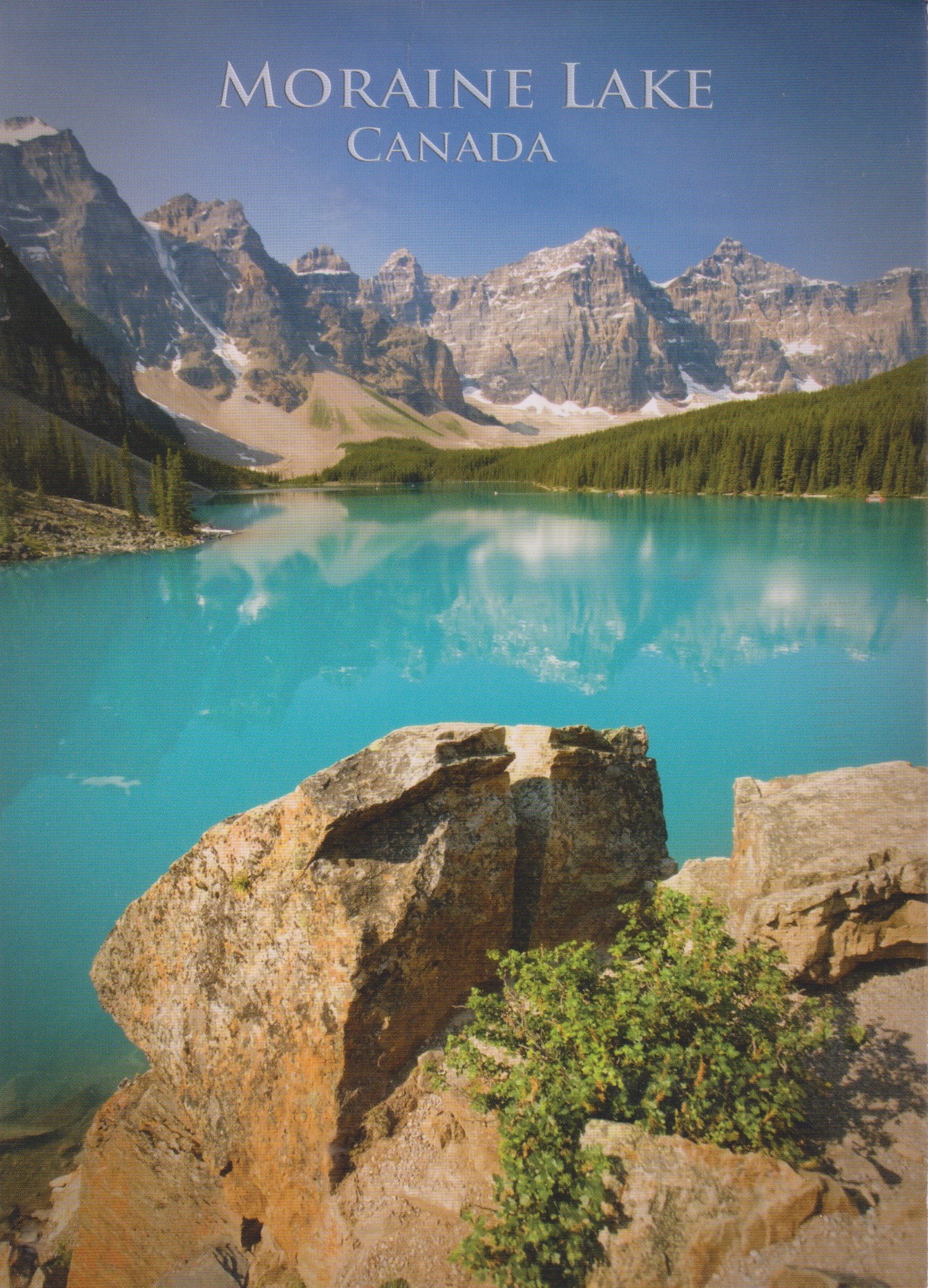
Postcard 6 - Moraine Lake
Nice reflection of Moraine Lake, Banff National Park. It is a UNESCO World Heritage site. Thanks to Maxine of Canada.

USA - Canada - Kluane, Wrangell-St Elias, Glacier Bay, Tatshenshini-Alsek

"These parks comprise an impressive complex of glaciers and high peaks on both sides of the border between Canada (Yukon Territory and British Columbia) and the United States (Alaska). The spectacular natural landscapes are home to many grizzly bears, caribou and Dall's sheep. The site contains the largest non-polar icefield in the world." 

Source: UNESCO World Heritage

Postcard 1A - CANADA - Kluane
Prepaid postcard by Canada Post - sent by April in Canada.


Postcard 1B - CANADA - Kluane
The Kaskawulsh is the most accesible glacier in Kluane Natinal Park, Canada. Thanks to Joanna of Yukon, Canada.


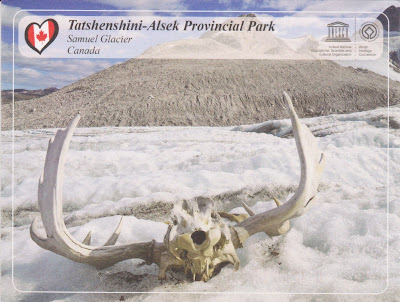
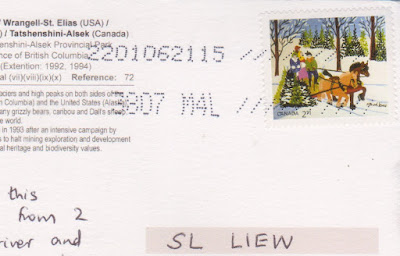
Postcard 2 - CANADA - Tatshenshini-Alsek
Nice postcard of Tatshenshini-Alsek of Canada is a joint UNESCO World Heritage with Kluane of Canada, Wrangell-St.Elias and Glacier Bay of USA. Thanks to Sandeep of Canada.


Postcard 3 - USA - Wrangell-St. Ellias
Ice Cave, Bagley Icefield interior of the Wrangell-St. Ellias National Parks of Alaska, USA.


Postcard 4 - USA - Glacier Bay
Riggs Glacier of Glacier Bay National Park and Perserve in Alaska, USA.

Canada - Joggins Fossil Cliffs

"The Joggins Fossil Cliffs, a 689 ha palaeontological site along the coast of Nova Scotia (eastern Canada), have been described as the “coal age Galápagos” due to their wealth of fossils from the Carboniferous period (354 to 290 million years ago). The rocks of this site are considered to be iconic for this period of the history of Earth and are the world’s thickest and most comprehensive record of the Pennsylvanian strata (dating back 318 to 303 million years) with the most complete known fossil record of terrestrial life from that time. These include the remains and tracks of very early animals and the rainforest in which they lived, left in situ, intact and undisturbed. With its 14.7 km of sea cliffs, low bluffs, rock platforms and beach, the site groups remains of three ecosystems: estuarine bay, floodplain rainforest and fire prone forested alluvial plain with freshwater pools. It offers the richest assemblage known of the fossil life in these three ecosystems with 96 genera and 148 species of fossils and 20 footprint groups. The site is listed as containing outstanding examples representing major stages in the history of Earth." 

Source: UNESCO World Heritage

Postcard 1
Joggins Fossil Cliffs of Canada. Postmarked Joggins, Nova Scotia on August 20, 2010 and arrived in Penang on September 3, 2010. Thanks so much to Karlie of Canada.


Postcard 2
Joggins in Nova Scotia, Canada is a UNESCO World Heritage site. Thanks to Julie of Canada. Mailed on October 8, 2021 and arrived in Penang on October 29, 2021 - travelling 3 weeks.


Canada - Rideau Canal

"The Rideau Canal, a monumental early 19th-century construction covering 202 km of the Rideau and Cataraqui rivers from Ottawa south to Kingston Harbour on Lake Ontario, was built primarily for strategic military purposes at a time when Great Britain and the United States vied for control of the region. The site, one of the first canals to be designed specifically for steam-powered vessels, also features an ensemble of fortifications. It is the best-preserved example of a slackwater canal in North America, demonstrating the use of this European technology on a large scale. It is the only canal dating from the great North American canal-building era of the early 19th century to remain operational along its original line with most of its structures intact." 

Source: UNESCO World Heritage

Postcard 1
Rideau Canal prepaid postcard by Canada Post. Thanks to Jason of Canada.


Postcard 2
Autumn splendor at Jones Falls Locks - Historic Rideau Waterway. Nice stamps used. Thanks to Ange of Canada.


Postcard 3
Ottawa - the capital of Canada was formerly called "Bytown" after Colonel John By who built the Rideau Canal. The upper part of the Rideau Canal for a few months in winter is turned into 8.5km long skating rink. Nice stamps used. Thanks to Manfred of Ottawa, Canada.


Postcard 4
Ottawa fireworks over Rideau Canal. Thanks to Jaeger of Ontario, Canada. Received postcard in Penang Island on November 5, 2019.


Canada - Writing-on-Stone / Áísínai’pi

"This site is located on the northern edge of the semi-arid Great Plains of North America, on the border between Canada and the United States of America. The Milk River Valley dominates the topography of this cultural landscape, which is characterized by a concentration of pillars or hoodoos – columns of rock sculpted by erosion into spectacular shapes. The Blackfoot (Siksikáíítsitapi) people left engravings and paintings on the sandstone walls of the Milk River Valley, bearing testimony to messages from Sacred Beings. The archaeological remains date from 1800 BCE to the beginning of the post-contact period. This landscape is considered sacred to the Blackfoot people, and their centuries-old traditions are perpetuated through ceremonies and in enduring respect for the places."

Source: UNESCO World Heritage


Postcard 1
2019 UNESCO World Heritage of Writing-on-Stone/Aisinaipi of Canada. Requested for this second postcard as the first postcard was slightly damaged by me accidentally spilling water. Thanks to Kelly again of Canada.


Postcard 2
Writing On Stone postcards from Kelly of Canada. This nice postcard with Year of Monkey stamp, as mentioned above, met a watery accident.


Canada - Pimachiowin Aki

"Pimachiowin Aki (“The Land That Gives Life”) is a forest landscape crossed by rivers and studded with lakes, wetlands, and boreal forest. It forms part of the ancestral home of the Anishinaabeg, an indigenous people living from fishing, hunting and gathering. The area encompasses the traditional lands of four Anishinaabeg communities (Bloodvein River, Little Grand Rapids, Pauingassi and Poplar River). It is an exceptional example of the cultural tradition of Ji-ganawendamang Gidakiiminaan (“keeping the land”) which consists of honouring the gifts of the Creator, respecting all forms of life and maintaining harmonious relations with others. A complex network of livelihood sites, habitation sites, travel routes and ceremonial sites, often linked by waterways, embodies this tradition."

Source: UNESCO World Heritage

An extra large size postcard showing the Traditional Native American Indian river cliff paintings in Woodland Caribou Provincial Park of Pimachiowin Aki. Many nice Canadian stamps used. Thanks to Jason of Canada.